Sunday, February 2, 2014

The Way South

I'm way behind with documenting my trips but there are a few locations I intend investigating again during my days off. I'd like to discover some fresh locations which haven't been 'over photographed'. Athough I am keen on exploring some of the Northern Beaches I realise I need to be in the right frame of mind in order to negotiate the traffic with as little angst as possible. So a little project I'd like to undertake is to create a video sequence of most of the beaches or interesting locations  from Wattamolla as far as Kiama. I generally dont find concrete pools particularly attractive, however there seem to be some hidden rock pools on the route which will make the experience more interesting for me. It is difficult to gauge the optimum time for photography at each of these locations because most of them are tide dependent.  High tide frequently blocks access to many of the rockshelves and unless you're careful it can be difficult to negotiate a way back to safety. I'd recommend visiting each of them at high tide and low tide which makes it quite a time consuming process.

Wannasurf - a great resource for surfing locations with maps .
A map of Wollongong beaches and rock pools 

Some of the locations yet to be explored or re-photographed:


 The beach is known as Jones Beach


Monday, January 27, 2014

The Tram Graveyard

I'd previously read about the graffiti covered trams which used to be housed in the former Rozelle tram depot, located in Glebe and as they've since been moved I was unable to get to see them. I have fond memories of tram travel as a child when I went out to visit my grandparents at Randwick. The following video provides a snippet of historical information .


It remained a great mystery as to where they've been taken and I was still on the hunt for them as they represent a wonderful memento from Australia's early history. The following video shows them before they were rehoused or perhaps many of them were simply destroyed.


Thanks to Alex Taylor (Visual Cocaine) another member of the Focus Group, I was alerted to the location of a few other old trams. As luck would have it the location was only a 15 minute drive from home. Alex had provided some great background and advice on his blog so I went very well prepared. I guess it's always a risk going to these places alone but everybody else was out celebrating Australia Day and I'd decided to visit mid afternoon so I was pretty sure it would be deserted.

Looking back through the images today I'd like to try and create a slideshow as a type of homage to these old veterans of the track. Everyone has their processing preferences for digital images and I think it's important for viewers to appreciate the intent behind the images. Many people dont like vignetting but I think it can be used to achieve a purpose. This is a secret location in many ways and the trams are only partially visible when the doors to the shed are slowly opened. I think vignetting is a method of doing a partial reveal which suits this location.
 I was quite saddened by my visit as the trains stand like prisoners crammed together side by side and susceptible to all forms of attack by vandals who have scant respect for their historical value. They stand in the dark littered with human detritus, scars of a myriad of attacks on almost every surface. Paradoxically, a few hundred metres away at the Loftus tram depot, their indulged cousins are housed in relative opulence and lovingly maintained by a league of volunteers. I wonder why some have been assigned to the graveyard and others have been championed ? I do admit to feeling a little uncomfortable in the dark alone and I wasn't inclined to attempt to board the less accessible vehicles, so I've probably missed out on some great shots. Spookily, after I'd left the sheds and was walking towards the exit there was a loud bang from inside, the source of which shall have to remain a mystery.

After 3 successive visits, one with company which was the most enjoyable shoot, I'm still working on processing the hundreds of shots I captured. I've also heard from a photo buddy that the trams share the shed with some brown snakes which has somewhat compromised the attraction of any future visits. I've recently uncovered some images of the transferring of the trams to this location and am somewhat surprised it attracted no media attention. 

Monday, January 13, 2014

Back To Bombo

Bombo is such an atmospheric location irrespective of weather or Season. There is always something to explore. I set off early with two friends,  and we were treated to some great photo opportunities, from fog enveloping the landscape on the trip down, to the craggy headlands and reflections of Bombo Quarry, then on to a feast of sunflowers in a garden at Kiama and finally, to the exciting discovery of a 'secret' cave at Cathedral Rocks. 
We were treated to some great foggy patches on the way down South and stopped a few times to try and capture the scene, however I was aware that we didnt want to linger and arrive at Bombo when the sun was too high.
The swell at the quarry was less than impressive but I was keen to show Megan and Carolyn the access point for high tides and big swells. I'd serendipitously uncovered a path of sorts on a previous visit which led through the bushes and allowed me to bypass the dangerous irregular rocks. There are a few natural rock stairs which allow you to look down onto the water.
After a few hours enjoying ourselves in the quarry we headed for the obligatory brunch and a refuel as we were so thirsty after being in the hot sun.  On our way into Kiama we were treated  to a display of sunflowers in a local garden. Megan's sharp eyes had seen them on our entrance into the township so they were well worth a stop. The wind interfered with our attempts to catch some really sharp shots but we at least have a digital memento from the day.

On the way home we made a detour via Cathedral Rocks as a type of recon trip for a future visit.  While speaking with a local, Carolyn discovered  there was an accessible walk to the top of the headland along Cliff Drive. It gave us some magnificent views down onto the Cathedral Rocks area and provided a number of new POVs to explore. 
 A few photographers have used the cave at the Rocks to frame sunrise shots however the exact location had proven to be elusive. We knew nothing other than the fact that it was only accessible at low tide so we were really excited to see it so clearly from our high vantage point.
 Its a wonderful view from up on the headland and has provided us not only with enjoyment on the day, but some ideas for future sunrise and sunset locations.
My only regret was missing out on the opportunity to capture an enormous sun filtered by cloud patterns as we were in the wrong place at the wrong time and Nature has her set timetable .

Friday, January 3, 2014

Potter Sunrise

Met up with some Focus buddies for the first 2014 sunrise shoot at Potter Point. Weather was a tad inclement so I decided to stay close to the car park. Can't afford losing yet another camera to water damage. There was a small band of pink which adhered to the horizon, but that was the only colour we were to experience. I've learnt my lessons about smeared glass, unstable tripods and the challenges of using zoom lenses for landscape shots so I'm pleased to say I was able to capture some long exposures with reasonable success. And as is the tradition we completed our shoot with breakfast, this time at the Silver Beach Cafe at Kurnell. Potter Point offers so many compositions and the colours which paint the rocks under all conditions are just breathtaking. Feel privileged to have the opportunity to combine photography and shoots with like minded company. 
 The following shot was taken just a few hours later just down the road. It really is all about the light :-)

 I love it when the sun has just  risen above the horizon and the golden light paints the rocky ledges and surface of the water with a golden glow.

Sunday, December 29, 2013

Musings on Mittagong Malting


Embarked on my third visit to the Mittagong Maltings with Mark Nolan, another photo buddy, hopeful for some better composed shots of this eerily addictive location. It is one of the few abandoned historical locations which are not encircled by mesh. Sadly, the disadvantages appear to be far outweighing the advantages as it appears more damaged with each visit, in spite of the fact that the National Trust of Australia listed the 103 year old structure as being among its “endangered places of 2000”. 

 Above: The second of the remaining main buildings -front access
The Mittagong Maltings Works was originally established by the Maltings Company of NSW (Ltd) to supply barley malt to breweries and operated from August 1899. It was  acquired by Tooth & Co. the major brewer of beer in New South Wales, in 1905, and operated until its closing in 1980.  John Tooth emigrated to Australia from Kent in the early eighteen-thirties, traded for a time as a general merchant, and then, in 1835, with his brother-in-law, John Newnham, opened a brewery in Sydney known as the Kent Brewery. Kent had always been the principal hop growing of the UK. The logo and trademark of Tooth and Co. was based on the Battle Standard of two Saxon Chiefs, Hengist (stallion) and Horsa (horse) who invaded Britain more than 1,400 years ago. The logo is still prominent on the face of the second main building. Admittedly the worse for wear, but still eminently recognizable.  

The Maltings were managed by three brothers Ernest, Clarrie and Arthur Jones. Their Father Henry was also the original manager of the Maltings from 1905 until his death in 1928. The Jones family had a combined service to Tooth and Co of well over 150 years.The Maltings had three separate buildings, one destroyed by a fire in 1965. The other two are now abandoned, having closed in 1981.


Above: The second of the main buildings

Purchased by a consortium for $1.5 million in 1999 the Maltings were then sold to Barry Anstee in 2000 for $590,000. He revealed plans to transform the three malting houses, railway station, manager’s residence and other small service buildings into a 50-room hotel, brewery and winery. Fate intervened and since being offered at auction in 2011, the site is slowly disintegrating with no sign of endeavours to rescue it from history’s dustbin.
Image: looking up at the entranceway to the second site
 
The brickwork, steel pillars and machinery still provide evidence of milling processes from another era however much of the building is now inaccessible due to crumbling or removed staircases. Graffiti covers most of the walls and there is evidence of unsuccessful attempts to successfully ignite some of the wooden components. 

A great write up of a visit to the Maltings was penned by “CosmicThunder” 


Saturday, December 7, 2013

Bombo Yet Again


One of the many advantages of returning to a location is the opportunity to discover new paths and access points. As with any  location adjacent to water flow it is vital to stand and watch for a substantial period in order to gauge the movement and rhythm of the waves. Even then, the ocean is unquestionably unpredicatable.It's always somewhat of a risk wandering in the Bombo quarry so it was with the utmost care that I endeavoured to search for some alternate perspectives. A fall at Bombo could mean being pounded against the rocks with scant opportunity to negotiate a return to land. Bombo is also apparently a snake's playground so the rocks present an additional hazard.

The expansiveness of the quarry is best viewed from the top of the cliffs just south of Cathedral Rocks.
 While the isolation of the location is a great drawcard for me it was reassuring to encounter a mum and her young son Oliver who frequently visit the quarry to allow Oliver's imagination free rein. They'd brought along a length of rope and Oliver was playing the cowboy with his mum the accommodating horse. The interaction between them was heartening to watch.

Sunday, December 1, 2013

Return To Bombo

Returned to my favourite location with the Southern Focus Seascapers Group. It meant an alarm set for 2.45 a.m and I was hoping we would be rewarded with some decent clouds at the very least. Nothing quite like turning the corner and hearing those waves crashing against the rocks. I've seen very few images which recreate that almost extra terrestrial atmosphere Bombo exhudes. Experimenting with the Pixel Blender oil paint plugin in PS helps to push the image beyond realistic which is not to everyones' taste, but then neither is Bombo. Many people perceive it to be too dark and brooding, the very quality which engages me. It exhudes an ambience I would imagine to be reminiscent of the Yorkshire moors and the very place where Heathcliffe could wander mourning his "Cathy".
Took us a while but Danielle and I were finally able to locate the path I'd previously uncovered through the bushes so we could climb up on some natural rock steps to get a view looking down on the waves crashing against the rocks.

Walking towards the northern end of the quarry the tall cliffs are replaced by a wall of irregular outcrops which serve as a barrier of sorts against the waves. Reflections are evident amongst the formations after a few rainy days or a monster tide which causes the waves to spill over into the quarry excavation. The entire quarry reminds me of a giant's marble pit with shards of rocks of different sizes strewn amongst the tussocks. We were gifted with some impressive cloud formations which created a great background for the wider landscape shots.
 The basalt rocks are sharp and sometimes slippery and it can be quite a challenge to negotiate a path to a particular vantage point.  Bombo lends itself perfectly to dark brooding processing because it is such an atmospheric location.
Two alternate interpretations
After the shoot it was off to Kiama for the traditional Focus breakfast at the Black Rock Cafe and lots of laughs.
Returning to Bombo on a day with a combination large swell and high tide is on the agenda.

Saturday, November 9, 2013

Watson's Bay

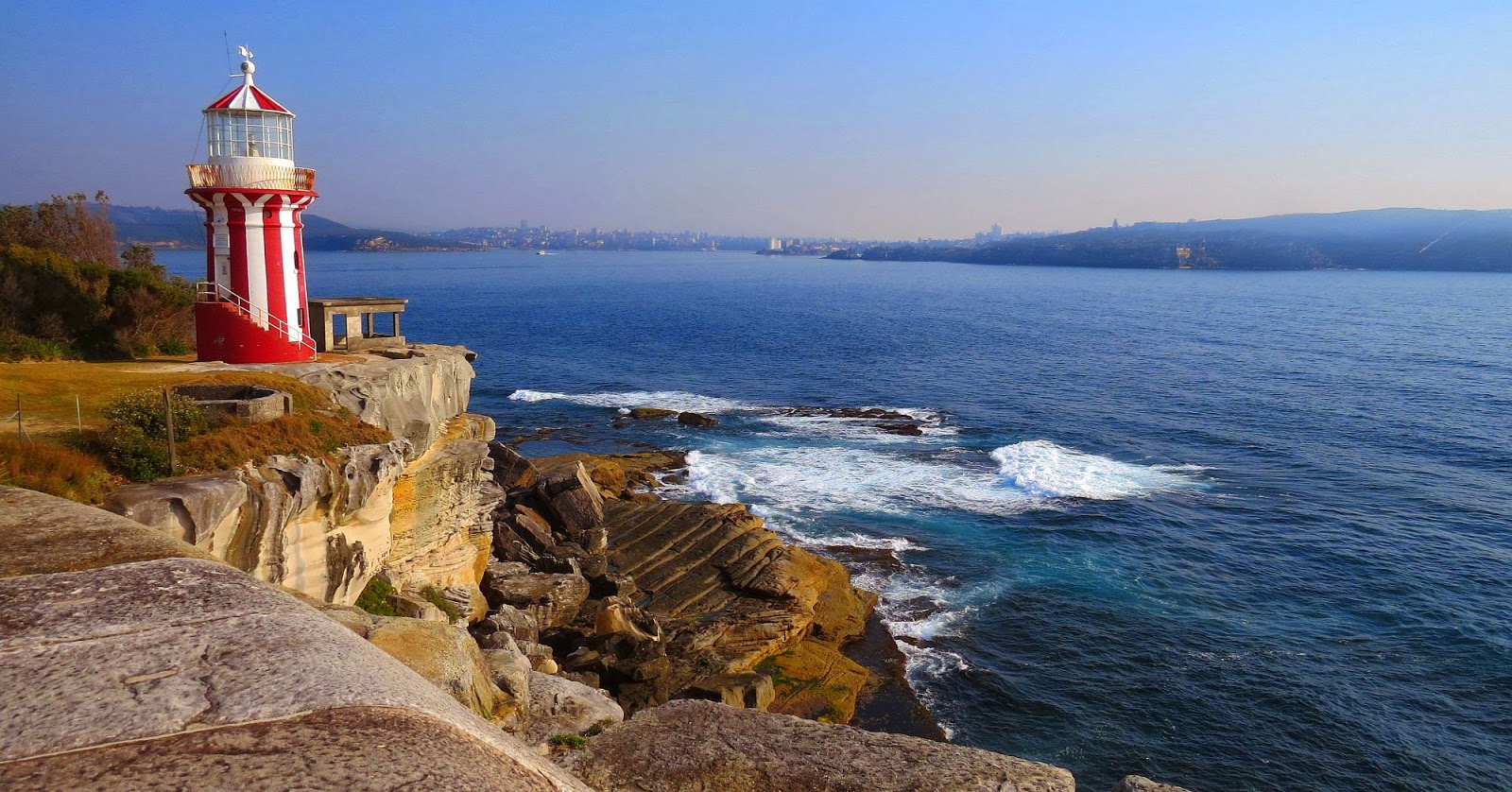
The opportunity to return to Watson's Bay presented itself as I was re uniting with a school friend I've known since Kindergarten.  I've visited Watson's Bay on numerous occasions but decided to leave home early and fit in a quick photoshoot before we were due to lunch together. The two lighthouses of course were on the agenda, as were the military bunkers. A tiny bit of research on the lighthouses of Australia site uncovered some interesting facts.
 "..............The Macquarie Lighthouse at South Head is Australia's first and longest operating navigational light with a flagstaff erected as a navigational aid in 1791, within one year of the First Fleet arriving to settle New South Wales. A wood and coal fired beacon, a basket on a tripod, was established in 1793 and was the only guiding light for the next 25 years.The construction of the current Macquarie Lighthouse was begun in 1881 and the light was first exhibited in 1883. It was designed by James Barnet and is a replica of the original tower completed in 1818 at the command of Governor Macquarie and designed in sandstone by the renowned convict architect Francis Greenway. Greenway emancipation for  his efforts and true to Greenway’s prediction the tower deteriorated due to the poor quality of the sandstone.  The existing tower was therefore built stronger in both materials and design. The lighthouse was fully automated in 1976 and the keepers were eventually withdrawn in 1989. Australia's first lighthouse keeper was Robert Watson. He was with the First Fleet as the Quartermaster on HMS Sirius and later Harbour Master at Sydney. Watson was already an old man and died within a year of his appointment. Nearby Watsons Bay was named to honour his memory............."
Hornby Lighthouse stands at South Head, near Watsons Bay in Sydney Harbour National Park. 
The iconic red and white striped tower is surrounded by views in three directions.  Sydney Harbour is to the west, Middle Head and North Head to the north, and the Pacific Ocean to the east. This lighthouse was built in 1858 following the wrecking of the Dunbar at the foot of South Head. Designed by colonial architect Alexander Dawson, Hornby Lighthouse was the third lighthouse to be built in NSW. An Irish seaman, James Johnson, the sole survivor of the 122 on board was found that morning clinging to a ledge. His family was to go on and play a significant role in the manning of New South Wales lighthouses. Seventy years after the arrival of the First Fleet it was the third lighthouse to be built, after Macquarie and Nobbys Head. It was known as the Lower Light to distinguish it from the nearby Macquarie Lighthouse and designed by colonial architect, Alexander Dawson. There is a great guide by Lewis Fogarty for Hornby at Free Photo Guides.  I arrived too late for sunrise, the light was already too harsh and the sky a flat blue, not the best photographic conditions.   

Monday, November 4, 2013

Sculptures By The Sea - Or Not !

This is my fourth year visiting the annual "Bondi Sculptures By The Sea" display and my response has been the same each time. As far as sculpture is concerned, it appears to me that "anything suffices".
I'm pretty sure the peoples' choice this year will be a water filled sphere which won a scholarship. Once again, as pretty as it may have been, many people have used spheres before and I think it's a shame that something so unoriginal won a scholarship. I'm not sure how locations are allocated but this one was certainly in pride of place.
 Lucy Humphrey's "Horizon"
It's imperative to commence the day early, and that means before sunrise otherwise the entire day is spent negotiating people, dogs and challenging lighting conditions. Alternately, stay late, real late, and go for long exposures.  It never ceases to amaze me how many people elect to do their daily stretches or take a rest break right alongside one of the sculptures, so either go early or be prepared to develop RSI from using the clone tool on the images you shoot. The event could easily be renamed "People By The Sea". Sometimes locating the sculpture is akin to finding Wally.
I have two indelible impressions about this event, reinforced on a yearly basis :
1. Many of the local joggers should be ashamed of their rudeness and selfishness when displaying their obvious contempt for all the visitors who dare to walk along the route. Grow up and accept the fact that for a few weeks each year you may find it advantageous to change your normal route and do a large favour to yourselves and visitors who have come to support this event.
2. Beauty is in the eye of the beholder
Now I've got that off my chest !
Another positive spin on the Sculptures scenario is that irrespective of the quality of the sculptures, there is usually an opportunity to capture some great surfing action at the same time.
I think it is important to be well prepared for the long viewing walk and to that end each year my first visit is to  purchase a program to obtain an overview; decide which sculptures I'm really keen on viewing including their locations,  and the most efficient method of navigating the route. Another factor which has a major bearing on the impact of the sculptures is their location and how the different light situations impact on their digital capture. Many people commence the walk at Mark's Park and by the time they reach Tamarama, many of the sculptures are in partial shadow. Therefore an initial visit allows me to decide on the best time to view each sculpture to its advantage.
Sculpture is defined in The Oxford Dictionary as:
the art of making two- or three-dimensional representative or abstract forms, especially by carving stone or wood or by casting metal or plaster.  
The British Arts Council extends the definition :
The current dictionary definition of sculpture as 'the art or process of creating representational or abstract forms, either in the round or in relief', does not tell the whole story.  This notion was first challenged over forty years ago when new practices and a greater diversity in the range and use of materials extended the vocabulary.  The term can now be said to encompass installation, land art, body art, performance art, text-based work, photography and video, as well as the three-dimensional art object.
I would still challenge some of the entries given that broad criteria. Perhaps I'm too much of a purist, but I would expect to see that some effort has gone into the creation of an artwork rather than simply using an existing object and giving it a title. e.g a porta-loo, a caravan and a stop sign with the letters rearranged. A red blog running down the hillside is not even worthy of consideration.

Looking back over previous year's images it's interesting to compare the 'van' sculptures from this year and 2005. I don't think it's difficult to see which sculpture required the greater effort and creativity.
 
Chris Bennie, grace, Sculpture by the Sea, Bondi 2013. Photo Clyde Yee
 Ben Resch, the great aussie surf trip, Sculpture by the Sea, Bondi 2005. Photo Clyde Yee
 So it's not that I'm against the sculptor's medium of choice, but how he or she decides to utilise it.

Judging creative pursuits is always a contentious issue because it is so very subjective so I apply my personal criteria when evaluating them. I figure if I could create it, then it's not great sculpture. I like to see evidence of 3D craftsmanship.  Not willing to be too much of a killjoy I still believe S.B.T.S is still a great experience, particularly for photographers, as many of the exhibits, due to their locations along the rocky foreshores  are notoriously difficult to photograph effectively. It's a great exercise in exploring Composition and battling the vagaries of light.
The following three photographs were taken of David Hashimoto's  Moment of Clarity at three different time slots.
VIEW.1
VIEW.2
 VIEW 3
If I'm able to visit next year, I aim to go at least once during the night and shoot some long exposures to ensure I have some people/torchlight free shots.